Saturday, February 9, 2013

Quinoa


Two years ago, I would have been challenged to find quinoa in my local supermarket but today not only can it be found among the now large selection of specialty grains, it is also on the impulse item shelf at the checkout counter.  Times have changed.  Perhaps it is because the Food and Agricultural Organization of the United Nations (FAO) officially declared  the year 2013 as "The International Year of the Quinoa”. 

Historically, this native grain of South America has been around since 1200 AD.  Along with maize, quinoa was one of the two mainstay foods for the Inca Empire

I am happy to see folks embrace this powerhouse grain.  Often considered the Mother of Grains, quinoa contains enough of the 20 amino acids to make it a complete protein with one cup of quinoa providing 8g of protein and 5g of dietary fiber. What’s more, the presences of these two macronutrients make quinoa perfect for regulation of blood sugar.     

Often I will recommend quinoa as a substitute for rice or cous cous. Most often people will typically prepare rice by steaming or boiling it, but I suggest giving quinoa a little more love.   Make it  pilaf style and use it  in salads, soups or as a replacement for other starches.  Try preparing quinoa this way and I am sure you’ll think twice before reaching for the rice or potatoes again.


Quinoa

Ingredients
2 teaspoons olive oil
1/3 cup diced carrots
1/3 cup diced celery
½ cup diced onions
2 teaspoons minced garlic
1 teaspoon salt
1 tablespoon chopped fresh thyme
1 cup quinoa
3 cups chicken/vegetable stock or water
¼ cup sliced scallions (optional)

Directions
Heat olive in a medium saucepan

Add carrots, celery, onions, garlic and salt; cover and cook until onions become translucent; add thyme

 then quinoa and liquid

Bring to a boil then reduce to a simmer

Cover and allow cooking until all liquid is completely evaporated


Remove from pot and garnish with scallions if desired
ENJOY!


Saturday, February 2, 2013

Okinawan Sweet Potatoes


This is Super Bowl weekend and my sister is preparing roast pork for dinner and asked me to bring the starch.  I am sure there will be plenty of nachos, chips and guacamole to snack on during the game.  With that in mind, I thought something wholesome perhaps.  She asked for something, “different” since she typically serves buttered noodles or potatoes with roasted pork. Then the ideal came to me as I walk in the produce section of a market in Flushing.  Okinawan Sweet Potatoes!
Hard to believe that something so…beige on the outside,
can be so beautiful and vibrant on the inside. 
Okinawan Sweet Potatoes are plentiful in Asian markets this time of year. These tubers are actually native to the Americas and believed to have made its way to Japan after 1492.   The Japanese people quickly embraced the Okinawan sweet potato where it is found in tempura, purees and some pastries.
The radiant purple hue is not without its health benefits.  Like most fruits/vegetables high in the purple-blue pigment, Okinawan Sweet Potatoes are rich in a flavonoid know as anthocyanin. Like blueberries, red cabbage and eggplant the Okinawan Sweet Potato is a powerful antioxidant that’s been shown to have positive affects on brain health and Alzheimer’s. It is also high in fiber and vitamin C. 

So, I decided to roast my Okinawan Sweet Potatoes making it easier to serve on a buffet.  The hint of citrus helps bring out the flavor of the potato and the ginger is a nice complement.


Okinawan Sweet Potatoes

Ingredients
3# Okinawan sweet potatoes
1/3 cup olive oil
2 tablespoons lime juice
2 tablespoons lemon juice
1 tablespoon chopped ginger
½ teaspoon salt
Orange zest (optional garnish)

Directions
Preheat oven to 350F
 Peel potatoes
Cut by hand or with a mandolin ¼ inch thick
Place in a large bowl; add olive oil, juices, ginger and salt. 
 
Toss until potatoes are well coated. 
 
Place on a cooling rack in a sheet pan.
Bake for 45 minutes or until potatoes are soft inside
Remove from oven allow to cool 

Garnish with orange zest if desired.

Saturday, January 26, 2013

Eggplant with Kalongi Seed


It is freezing here!  Today reached a high of 19F. Temperatures like this make me want to abandon my early Saturday morning routine of exercise, food shopping and errands.  In this area, there is no one-stop supermarkets.  Many little markets cater to different cultures.  It’s what I love about this borough, but on a frigid day, the last thing you want to do is be outside.  I was in the mood for Indian today.  Jackson Heights has some great restaurant but I have to admit, the food is quite hot.  I don’t mind the spices, in fact like them, but the pepper is often more that I can bare. So, I come up with my own rendition of my favorite Indian foods.  This one is made with eggplant. It is not spicy, the eggplant is baked instead of fried and olive is used in place of ghee.   Eggplant with Kalonji seed is always delicious with  brown basmati rice or paratha.  It’s very simple to make and I hope you will add it to your collection if Indian recipes. 


Eggplant with Kalongi Seed
1 large eggplant
2 teaspoons garam masala
¼ cup plus 1-tablespoon olive oil
16 oz diced can tomatoes or 4 large plum tomatoes, peeled and diced
1 tablespoon grated ginger
1 tablespoon chopped garlic
1 teaspoon seeded and sliced chili pepper
½ teaspoon fennel seeds
1 teaspoon kalonji seeds
1 tablespoon ground coriander
1 tablespoon fresh ground turmeric or 1 teaspoon dried
1 teaspoon salt

Preheat oven to 350F
Cut eggplant lengthwise in eighths, then cut each of those pieces on a bias into thirds.*
Place eggplant in a medium bowl; add ¼-cup olive oil, garam masala and a little salt. Toss and place on a sheet pan and bake for 20 minutes.

While baking the eggplant, heat a large saute pan with 1-tablespoon olive oil.

  Add ginger, garlic, chilies and fresh turmeric.  Saute for about five minutes

 then add dried spices sauté for one minute more 

then add tomato.  Simmer for 10 minutes stirring occasionally. 

 Add eggplant cover and simmer on very low flame for 10 minutes more. 
  
Remove from heat and serve. 


*If you find that eggplant makes your mouth itch, you make want to lightly salt the eggplant and let stand for one hour before baking it. 

Sunday, January 20, 2013

Preserved Meyer Lemons


At work, January is the slow season .  Almost all of my country clubs are closed and the ones that are open this year are spending most of their time rebuilding after the destruction of super storm Sandy. As I drive down the winding country roads, the overcast gloom of the season passes a dark shadow over the once beautiful green golf courses.  It will look like this for the next three month.  In the meantime, my mission is to brave new territory and find customer who are not affected by cold weather and brown grass.  I take a break to do some shopping.  Meyer lemons are in season now, so I couldn’t resist picking them up. 

Native to China, this flowery, low acid citrus fruit is believed to be a cross between a Mandarin orange and a lemon.  Brought to the United States by agriculturalist Frank Nicholas Meyer in 1908, these sweet "lemons" became very popular in California, but were found to carry a virus that wiped out other citrus. As a result, most Meyer lemons were destroyed in the 1940’s.  However, in 1975 the University of California modified the Meyer lemon to what we know today.  Stories like this really put me on the fence concerning nonGMO foods but I will not go there. 

I need to preserve more Lemons for the year.  There is probably one left over in the refrigerator from last year.  In addition to using them as an ingredient in roast fish, tagines, stews and salads they are excellent in Martinis.  This is probably why I have so little left.

Many recipes call for just covering the lemons in salt for one month but I find that covering them with salt and pouring hot water over the lemons preservers them a little faster.  This method is particularly valuable when using regular lemon because it helps to soften up the skin.  I don’t give exact measurement but I am sure you will understand why as you begin to preserve your lemons.  With the exception of the salt none of the other ingredients are mandatory. 
A word of advice however, if are going to use the lemons in a Martini someday, you may want to leave out the chili pepper.


Preserved Meyer Lemons

Ingredients
Meyer lemons
Salt
Saffron threads
Coriander seeds
Cinnamon stick
Chili pepper
Sterilized glass jar for preserving
Hot water  

Directions
Was lemons;
trim and quarter down to 1/4 in from the bottom

Generously salt the insides before placing them in the jar

Cover lemons with a generous amount of salt
Pour boiling water over the lemons; wipe off excess salt and moisture from around the jar.
 
Seal the jar.  In order to make sure the lemons stay submerged in the liquid I put a small top in the jar. you can store in the refrigerator, that is were I keep mine or in a cool dry place. In one month they are ready to use. 

Saturday, January 12, 2013

Neighborhood Chicken and Vegetable Soup


First I’d like to thank Tracy for allow me to be a part of a her future video post on  Bon Health.  Tracy is a holistic health coach, fellow foodie and upstairs neighbor.  Video of this soup will appear in the March addition of her blog. 

There are at least 128 nationalities represented in my neighborhood.  Often referred to as the Little United Nations, Astoria is a bustling destination of ethnic restaurants and cultural markets.  As I walk down 30th Avenue the aroma of Bosnian meat pies, Lebanese sausage and fresh Italian bread fill the air.  This is a food lovers’ paradise. That is why this seemingly ordinary dish is full of unexpected textures and flavors.  Neighborhood Chicken and Vegetable Soup pays tribute to the many  traditions I encountered today as I gathered the ingredients to prepare this soup. Don’t be intimidated by the  numerous components.  It's just soup! You can always omit or substitute.


Neighborhood Chicken and Vegetable Soup

Ingredients
2 pound boneless chicken dark and white meat-cubed
1 tablespoon Shaoxing
1teaspoon onion powder
1 teaspoon garlic powder
1 teaspoon salt
1 teaspoon ground pepper
1 tablespoon olive oil plus 1 teaspoon more
1 small red onion, julienne
2 leeks white part only, julienne
2 stalks celery, julienne
2 carrots, julienne
1 red pepper, julienne
2 teaspoons garlic minced
1 tablespoon fresh turmeric or 1 teaspoon dried
1 tablespoon ginger
1 tablespoon fresh oregano
1 tablespoon fresh cilantro
1 teaspoon Serrano pepper
2.5 quarts chicken broth
1 cup peeled dices potatoes
½ cup amaranth
½ cup fresh frozen green chick peas
2 cups Calabaza , medium cubed
4 sliced radish

Garnish
1 avocado
1 lime


Directions
Season chicken with onion powder, garlic powder, salt, pepper and Shaoxing.  Let marinate for at least ½ hour.
Heat a large Dutch oven, 1 teaspoon olive oil.  Sweat all julienne vegetables until celery starts to become translucent. 
Add garlic, turmeric, minced ginger and Serrano peppers.  Remove vegetables.  Add 1 tablespoon olive oil; sear chicken until meat gets brown.  When chicken browns add vegetables, herbs and chicken stock.
Bring to a boil; add amaranth, potatoes and green chic peas. Simmer until potatoes become tender-about ½ hour
Add Calabaza and radish; simmer for about 15 minutes or until Calabaza becomes tender but not mushy.

Correct the seasoning as desired

Serve; garnish with diced avocado and a twist of lime juice.

Side notes. 
I liked this soup but Tracy wanted it to have a little more body so I added a chickpea flour slurry. ( 2 tablespoon chick pea flour and 2 tablespoons  water)  This is optional.

Saturday, January 5, 2013

Berbere Spiced Grits Stick

 
Many of the traditions that influenced southern cuisine, particularly African American eating traditions, began in West African cultures.  For instance the custom of eating grits can be traced back to West Africans, who routinely ate porridge made with millet and other indigenous grains.  This practice is alive and well in my home.  Grits, "low fat" bacon and eggs over easy is just the meal to tie you over while sitting in church.  However,  I am always intrigued by new ways of preparing old favorites.   Since there was some Berbere Spice left over from last week, I thought it would be the perfect addition to grits served at dinner time.   

 
Berbere Spiced Grit Stick
Ingredients
1 cup quick grits
3 ½ cups chicken stock
2 teaspoons Berbere Spice (see post from 12/31)
½ teaspoon garlic powder
½ teaspoon onion powder
¼ cup Romano cheese
¼ cup cheddar cheese
 
1 cup flour
½ teaspoon salt
 
Oil for frying
 
Directions
In a medium sauce pot, bring chicken stock to a boil
Add grits; whisk until grits come to a boil; reduce heat; cover and allow simmering for about 7 minutes-stirring occasionally
Add spices and cheeses; simmer for 2 minutes more
Spray a 7x10 inch pan with  food release
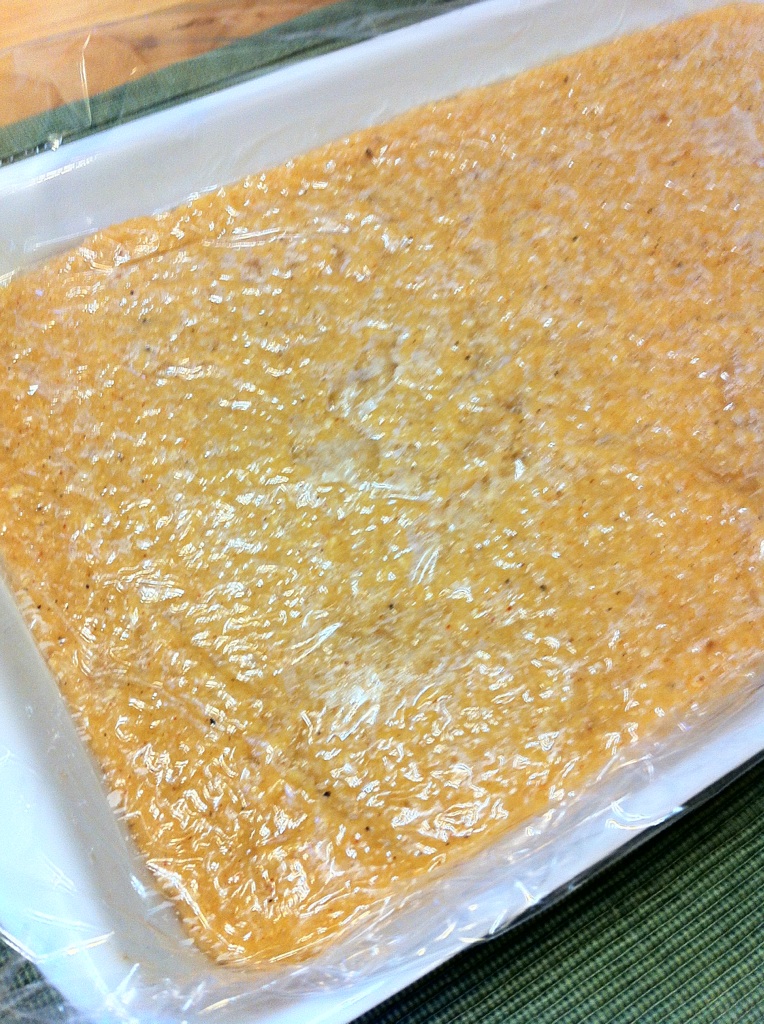
Pour grits into pan, cover grits with plastic wrap allowing the plastic to touch the grits as shown
Refrigerate to cool
 
While grits are cooling, you can prepare a quick Roasted Garlic Saffron Aioli.  I say quick, because these are ingredients I have lying around my refrigerator but for those of you who don’t, any type of Aioli or Remoulade will suffice.
 Roasted Garlic Saffron Aioli
 
Ingredients
3 cloves roasted garlic
3 threads saffron
2 tablespoons mayonnaise
Pinch cayenne
1 teaspoon sour cream
Directions
In a small bowl mash garlic until smooth
Add remaining ingredients and stir.
Refrigerate until ready to use.
 
When grits are cool remove from pan and cut into 3 x ½ inch sticks
Combine salt and flour for dredge.
Toss grits stick in seasoned flour
Fry; drain on paper towel
Drizzle Aioli over stick and serve
 
This was the perfect accompaniment to baked trout and a salad!